Fossil tooth found in North Dakota suggests mosasaurs hunted in freshwater rivers
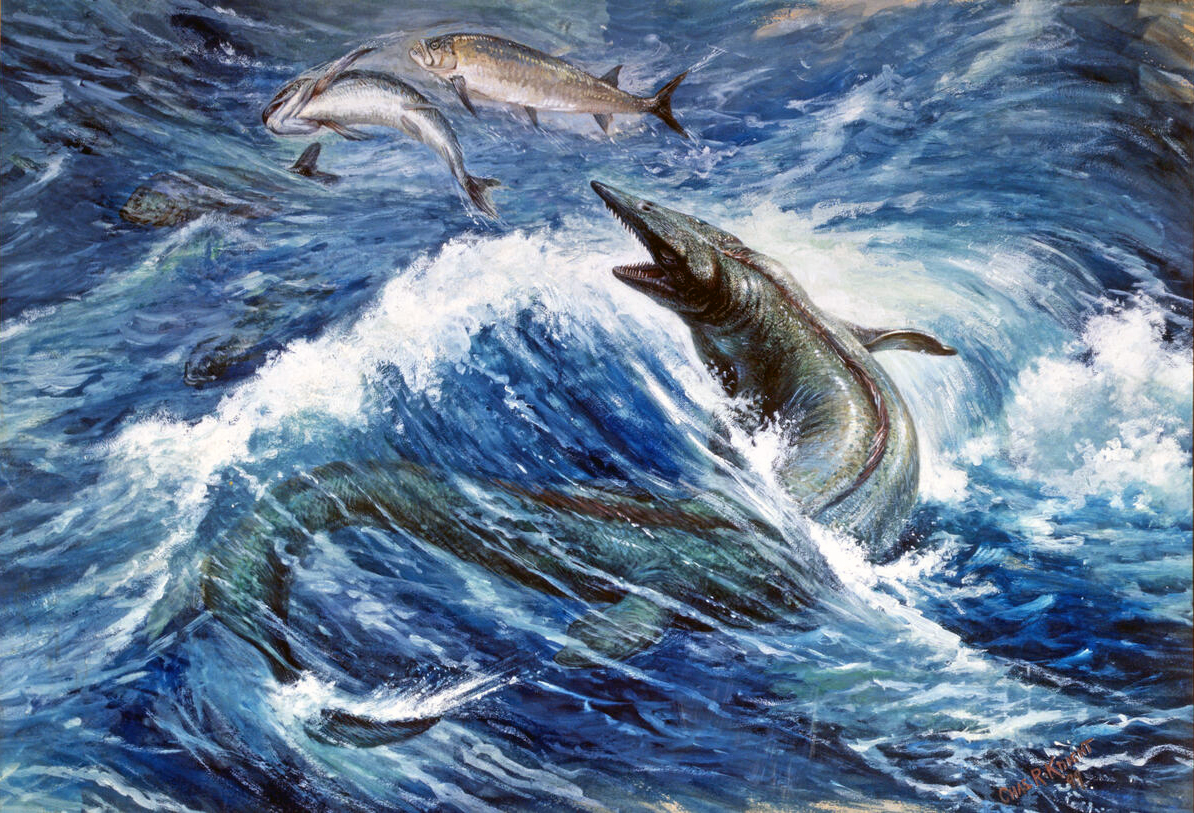

Mosasaurs, long imagined as terrifying ocean predators, may have also hunted in freshwater rivers, according to a recent study.
In an article published in December in the academic journal BMC Zoology, titled “King of the Riverside”, a multi-proxy approach offers a new perspective on mosasaurs before their extinction, paleontologists Melanie A.D. During and Nathan E. Van Vranken and their co-authors argued that “mosasaurs, traditionally considered marine reptiles, could inhabit freshwater environments”.
Mosasaur tooth found among terrestrial fossils
Their conclusion stemmed from the discovery of a single fossil mosasaur tooth, found in the Hell Creek Formation layers of Morton County, North Dakota. The Hell Creek Formation is a section of geologic layers found in the Western United States that date back to the Late Cretaceous, some 66-68 million years ago. The Hell Creek Formation is produced fossils of iconic Cretaceous dinosaurs like Tyrannosaurus and Triceratops.
The Hell Creek Formation was also home to a number of marine reptile species, like mosasaurs, plesiosaurs and sea turtles, that lived in an ancient inland sea known as the Western Interior Seaway (WIS).
The discover was surprising in that the mosasaur tooth did not appear to have been found in a location that was part of the WIS. It was located directly next to a fossil tooth from Tyrannosaurus rex and within the immediate vicinity of other remains from the “duck-billed” dinosaur Edmontosaurus and the alligatorid Brachychampsa. Based on the mosasaur tooth’s location next to fossils of land animals, the authors’ hypothesized that mosasaurs may have hunted in inland, freshwater rivers.
Isotope analysis supports a freshwater origin
The authors conducted an isotope analysis on carbon and oxygen isotopes in the mosasaur tooth and compared them to fossil specimens of known terrestrial and marine species. The conclusions? The authors found that the mosasaur tooth was “consistently closer to terrestrial taxa than to marine, with the δ13C [the ratio of carbon-12 to carbon-13] values exceeding beyond those observed in the terrestrial taxa and, therefore, potentially reflecting diet”. The authors also extracted small samples of calcium carbonate from the tooth for a strontium isotope analysis which also supported “a freshwater origin” for the tooth.
During and Van Vranken concluded from the isotope studies that “the tooth was formed while the mosasaur lived in a freshwater setting” and that the rivers of the Hell Creek Formation were capable of supporting large animal species 66 million years ago. They believe that certain mosasaurs moved into rivers as part of their ability to adapt to “various ecological niches during the Late Cretaceous.”