Fossil forelimbs found in Utah prove to be record-breaking stegosaur
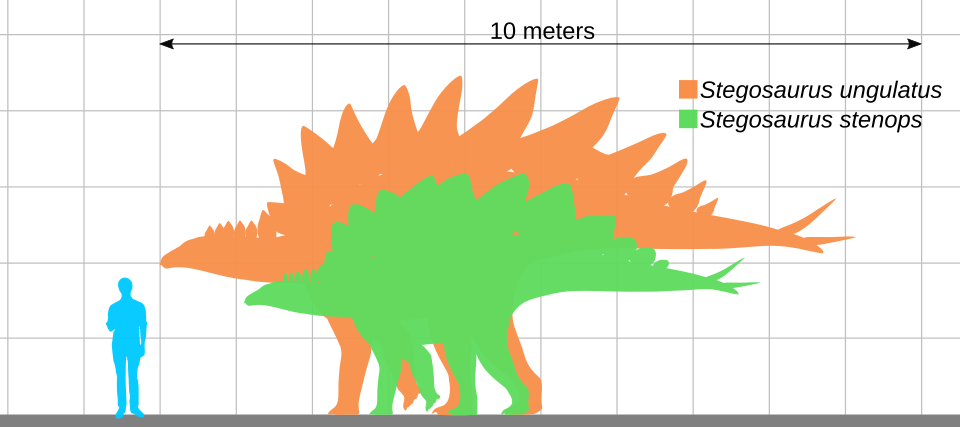

A recent publication on an old fossil find from 1950 suggests that stegosaurs, the iconic group of spiky dinosaurs, may have grown even larger than previously known.
In an article published last month in the ‘New Mexico Museum of Natural History and Science Bulletin 102’,a team of scientists led by ReBecca Hunt-Foster, a vertebrate paleontologist with the National Park Service’s Dinosaur National Monument in Vernal, Utah, reported on a set of fossil remains that appear to be from the largest stegosaur ever found in the Morrison Formation. The full article is available for free via ResearchGate.
The Morrison Formation is a sequence of sedimentary rock layers from the Upper (i.e. late) Jurassic Period, roughly 156 to 146 million years ago. Sections of the Morrison Formation can be found across much of the Western United States. The Morrison was home to many famous dinosaurs, including Stegosaurus, the terrifying Allosaurus, and the immensely long Barosaurus, which romaed as far north as Montana.
Fossil forelimbs
#3) One big f-ing stego Sadly, it's only know from partial forelimbs, but we document a stego that based on limb dimension is ~38% longer than the average stego. Assuming we could generally scale isometrically (don't come at me!), that all equals the largest specimen thus far.
— Cary Woodruff (@doublebeam.bsky.social) January 24, 2026 at 4:00 AM
[image or embed]
The team was able to identify the forelimbs as belonging to a stegosaur, though they were unable to narrow down to a particular species or genus. In addition to the eponymous Stegosaurus, other stegosaurs known from the Morrison Formation include the smaller genera Hesperosaurus and Alcovasaurus.
The forelimbs were discoverd in Uintah County, Utah in 1950 and not recognized as being from a stegosaur at the time, likely due to their incredible size.
The forelimbs measured in at 38% longer than those of other stegosaurs found in the Morrison Formation. As the authors discussed in the paper, the forelimbs appear to be from:
“a particularly large and robust individual that appears to represent the largest individual stegosaurid in the Morrison Formation in terms of both linear dimensions and estimated body mass.”
Cary Woodruff, Ph.D., curator of vertebrate paleontology at the Frost Science Museum and one of the paper’s co-authors, described the specimen more succinctly in a post on Bluesky: “One big f-ing stego”.
Stegosaurus is my favorite dinosaur!