A single neckbone proves this dinosaur once roamed Montana
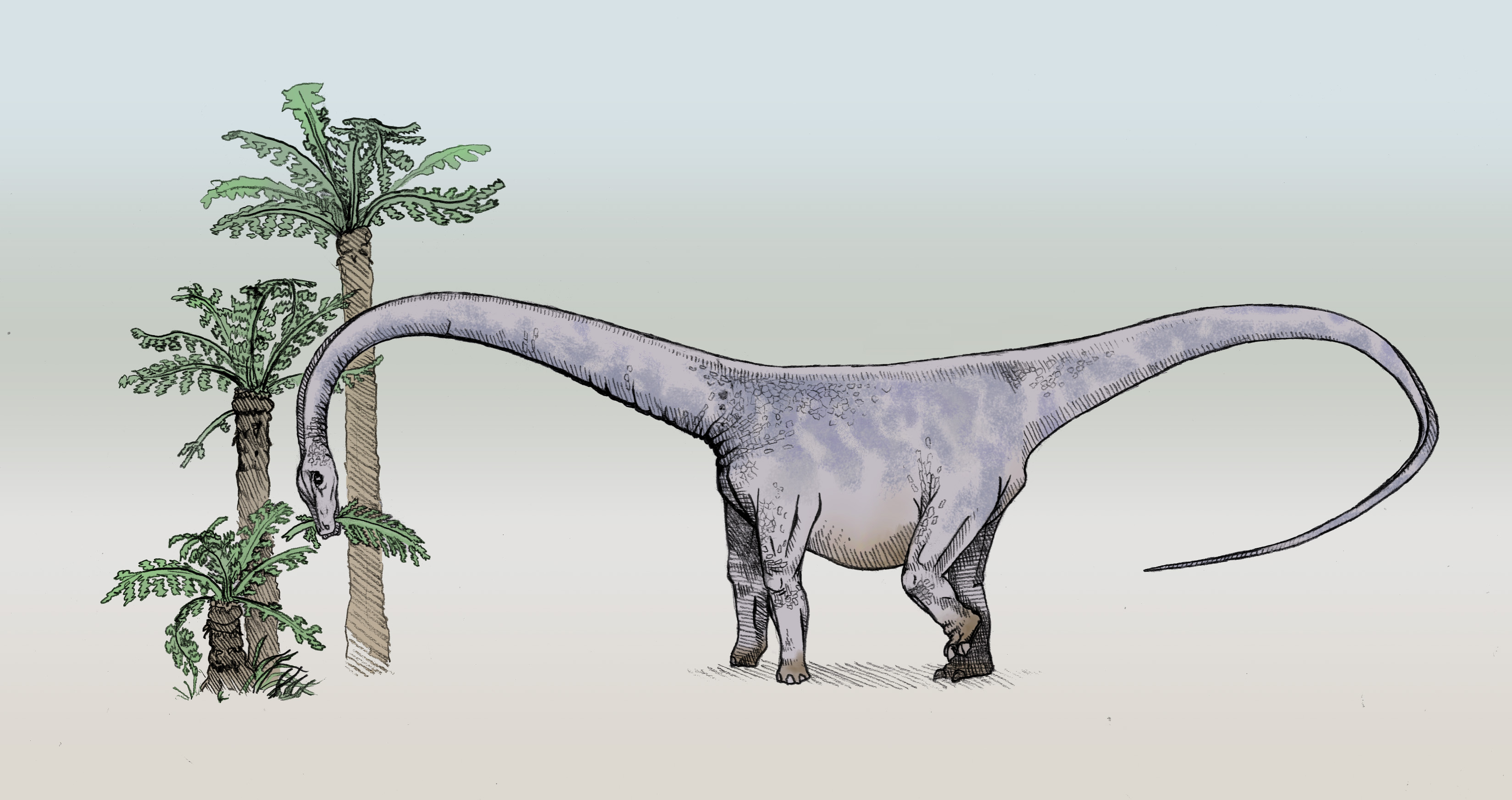
A sketch of Barosaurus. Artwork by Debivort and under a Creative Commons ASA 3.0 license, via Wikimedia Commons

The Morrison Formation is a sequence of sedimentary rock layers from the Upper (i.e. late) Jurassic Period, roughly 156 to 146 million years ago, found across much of the Western United States. The formation yielded up the fossilized bones of many iconic dinosaur species, including beloved Stegosaurus and the fearsome Allosaurus.
The Morrison Formation is also notable for being home to many species of sauropods - the herbivorous “long-neck” dinosaurs. The Morrison Formation includes sauropod super-stars like Brachiosaurus and Apatosaurus (the artist formerly known as “Brontosaurus”), as well as an ensemble cast of B-list celebs like Diplodocus and Camarasaurus.
A new discovery published this month is extending the known range of one of the Morrison sauropod species, while also providing supporting evidence for an intriguing environmental hypothesis.
A long-neck neckbone
A social media post from Elevation Science displaying a sauropod cervical vertebrae
One Morrison Formation sauropod, Barosaurus lentus, is known from fossil finds across several states, including Wyoming, Utah, Oklahoma and South Dakota. Until now, Barosaurus was not known to have lived in Montana, at the northern end of the Morrison Formation.
In an article this month in the ‘New Mexico Museum of Natural History and Science Bulletin 102’, a team of four scientists published the details of a fossilized cervical vertebrae (neckbone) found in the Pryor Mountains of south-central Montana. The full article is available for free online via ResearchGate.
The scientists - Cary Woodruff, Ph.D., curator of vertebrate paleontology at the Frost Science Museum, and Jason Schein, Katie Hunt and Skye Walker of the nonprofit Elevation Science - provided a detailed analysis of the neckbone, which they identified as belonging to Barosaurus.
An ecological indicator?
Paleontologists generally group the sauropod species from the Morrison Formation into two families: the long, sleek, “diplodocids” which include Diplodocus, Apatasaurus and Barosaurus, and the wide-nostril “macronarians” which include Camarasaurus and Brachiosaurus (you remember the sneezing Brachiosaurus from 1993’s Jurassic Park, don’t you?).
The team’s discovery of Barosaurus in Montana provides additional evidence for a hypothesis among some paleontologists that the northern end of the Morrison Formation may have been more ecologically favorable to the diplodocids than the macronarians. The authors stated in their paper that:
While Barosaurus is known from South Dakota and Wyoming, its absence in Montana has generally been perceived […] as a sampling bias opposed to a true indication of the lack of this taxon from the regional Morrison ecosystem. However, as noted for the apparent rarity of the macronarian Camarasaurus in Montana, the paucity of such taxa which are otherwise highly abundant elsewhere within the Morrison Formation could alternatively indicate slight ecological differences that were neither favorable nor preferred by certain taxa.
I was curious about this possible ecological distinction that favored the diplodocids. I reached out to Elevation Science, and received a response from Skye Walker, science communication manager for Elevation Science and one of the paper’s co-authors.
“In the paper, we treat this as a possible ecological signal rather than a definitive conclusion,” Walker said. “The [identification] of Barosaurus in Montana adds another data point to a broader pattern in the northern Morrison, where diplodocids seem to be more common than macronarians. But we do note that this pattern could reflect a combination of ecological differences, sampling bias or both!”
Barosaurus is my favorite dinosaur!