When muskox tromped through Michigan
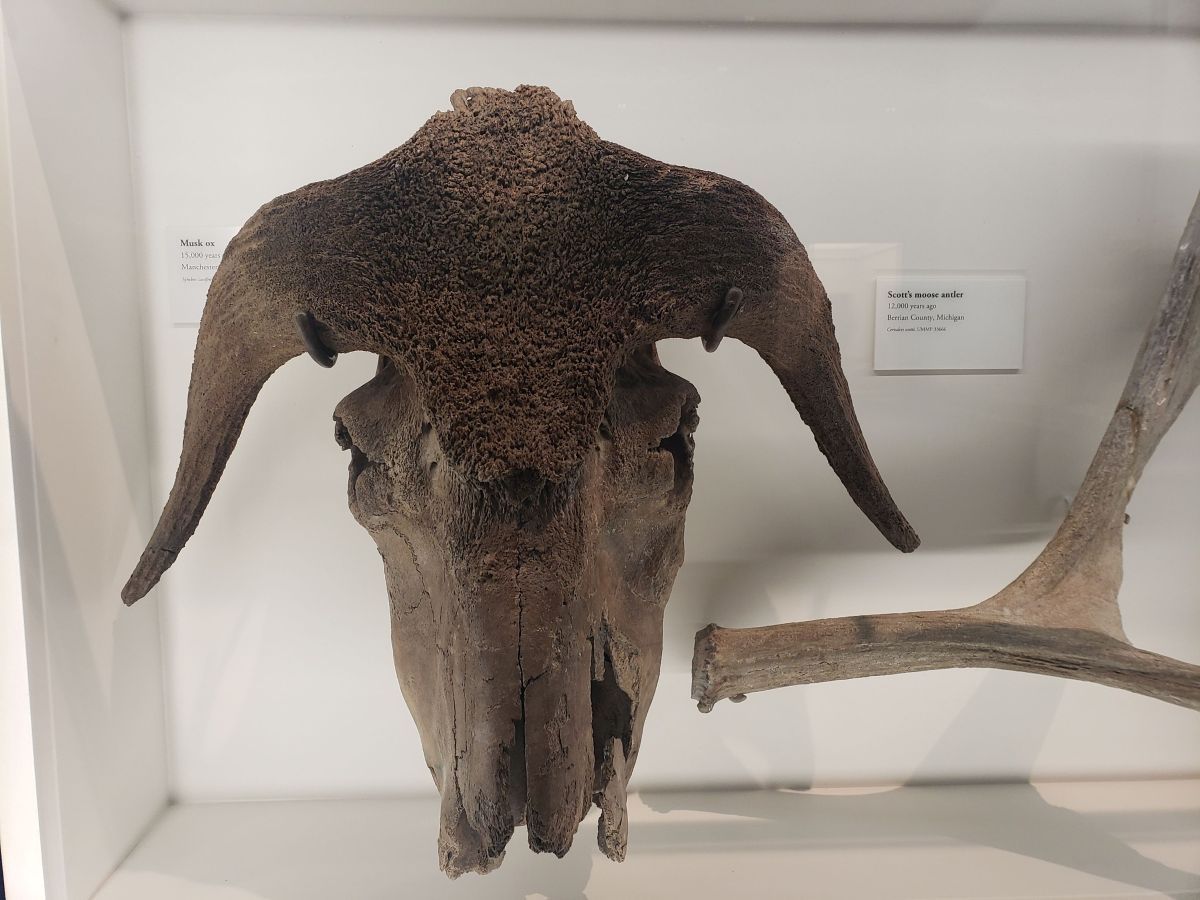
There’s a fossilized muskox skull at the University of Michigan Museum of Natural History. The skull is currently on display on the museum’s first floor in the ‘Exploring Michigan’ gallery.
The label next to the skull reads:
Musk ox
15,000 years ago
Manchester, Michigan
Symbos cavifrons
Manchester is a small city in Washtenaw County, Michigan, the same county that is home to the University of Michigan’s Ann Arbor campus (Go Blue!). Symbos is a genus of extinct muskox, though today paleontologists generally consier Symbos to be a synonym for the genus Bootherium, another extinct muskox genus (in layman’s terms, the two are really the same species). Modern, living muskox are members of the species Ovibos moschatus.
The fossilized skull was first described over a century ago in a 1915 paper by Michigan paleontologist Ermine Cowles Case. The paper, titled On a Nearly Complete Skull of Symbos cavifrons Leidy from Michigan, is currently available online via Wikisource.
Case explained that the skull had been discovered at a local farm:
The skull was found on the farm of Wm. J. Schlicht, about three miles northeast of Manchester, Michigan, in the excavation of a drain. It lay on a bed of clay four feet below the level of the rather swampy surface and was covered by a black muck filled with plant remains and interrupted by a few thin layers of fine gravel.
Case believed the skull belonged to a bull muskox in the genus Symbos and that it was too large to be from the genus Bootherium, which was believed to be the smaller of the two. Today, paleontologists generally believe that Symbos are larger, male, members of species Bootherium bombifrons.
Even back in 1915, Case was aware of the debate about Symbos and Bootherium being the same species. In describing the Manchester skull, he touched on the issue, explaining that:
Differences of opinion have resulted in considerable discussion of the exact nomenclature of this animal, some considering Symbos as a mature form of Boötherium, but the differences in the two forms as revealed by recovered specimens warrants the retention of the two names, at least provisionally.
While Case follows the convention in considering the two as different species, he does so “provisionally”. It seems that in Case’s time, some paleontologists thought Symbos and Bootherium were the same species, but represented different growth states, with the larger Bootherium being the adult form.
Paleontological debates aside, the fossil muskox skull is a fascinating reminder that muskox, though confined to Arctic and sub-Arctic regions today, once tromped all across North America, including Michigan.
Case remarked on the impressive range muskox had during the Ice Age, stating that “Symbos ranged well over the United States in Pleistocene times, one specimen having been found as far south and west as Oklahoma.” More recently, Bootherium fossils have been found as far south as Texas. Another genus of extinct muskox, Speleotherium, ranged into Mexico and Central America.